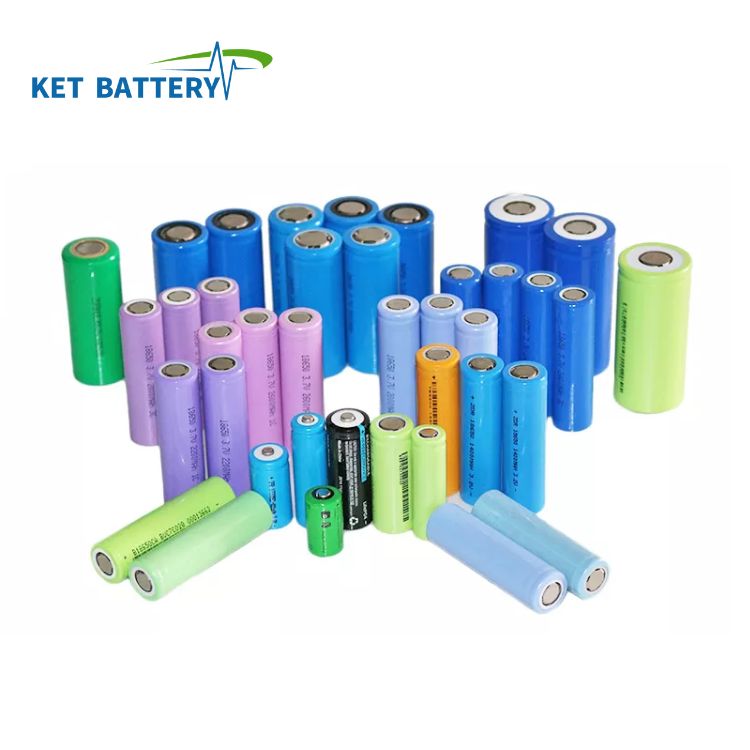
Battery type: rechargeable lithium ion 18650 battery cell
Voltage: 3.7V
Nominal capacity: 1800mAh 2000mAh 2200mAh
2400mAh 2500mAh 2600mAh
Range voltage: 2.75V ~ 4.2V
Advantages: safe, eco friendly, high energy density,
lowtemperature performance
Cell brand: Samsung, LG, Panasonic, Sony, BAK, etc.
Note:
KET is not just a battery wholesaler, but a battery customizer. As there will be different capacity, voltage, and size for different application scenarios. So please make sure you tell our sales your actual needs, and they will provide you with battery solutions and quotation in the shortest time.

Both lithium-ion (Li-ion) and lithium iron phosphate (LiFePO4 or LFP) batteries are commonly used in electric bicycles (e-bikes). Here are some differences between the two:
1. Composition: Li-ion batteries use a cathode made of lithium cobalt oxide (LCO), lithium manganese oxide (LMO), or lithium nickel manganese cobalt oxide (NMC). LFP batteries use a cathode made of lithium iron phosphate.
2. Energy density: Li-ion batteries have a higher energy density, meaning that they can store more energy in a given volume compared to LFP batteries. This makes them more suitable for applications where weight and size are important considerations.
3. Safety: LFP batteries are generally considered to be safer than Li-ion batteries because they are less prone to overheating and catching fire. However, this also means that they have a lower energy density and may not be suitable for high-performance applications.
4. Life cycle: Li-ion batteries generally have a higher number of charge/discharge cycles compared to LFP batteries. However, the difference in cycle life between the two types of batteries is not significant in most e-bike applications.
5. Cost: LFP batteries are typically less expensive than Li-ion batteries.
Overall, the choice between Li-ion and LFP batteries for an e-bike will depend on the specific requirements of the application, including weight, size, performance, and cost.